
Pressure Washing
Why Does Concrete Get Stripe Marks After Pressure Washing?
A simple look at why 'tiger stripes' happen on driveways and how professional techniques keep concrete looking clean and uniform.
September 19, 2026
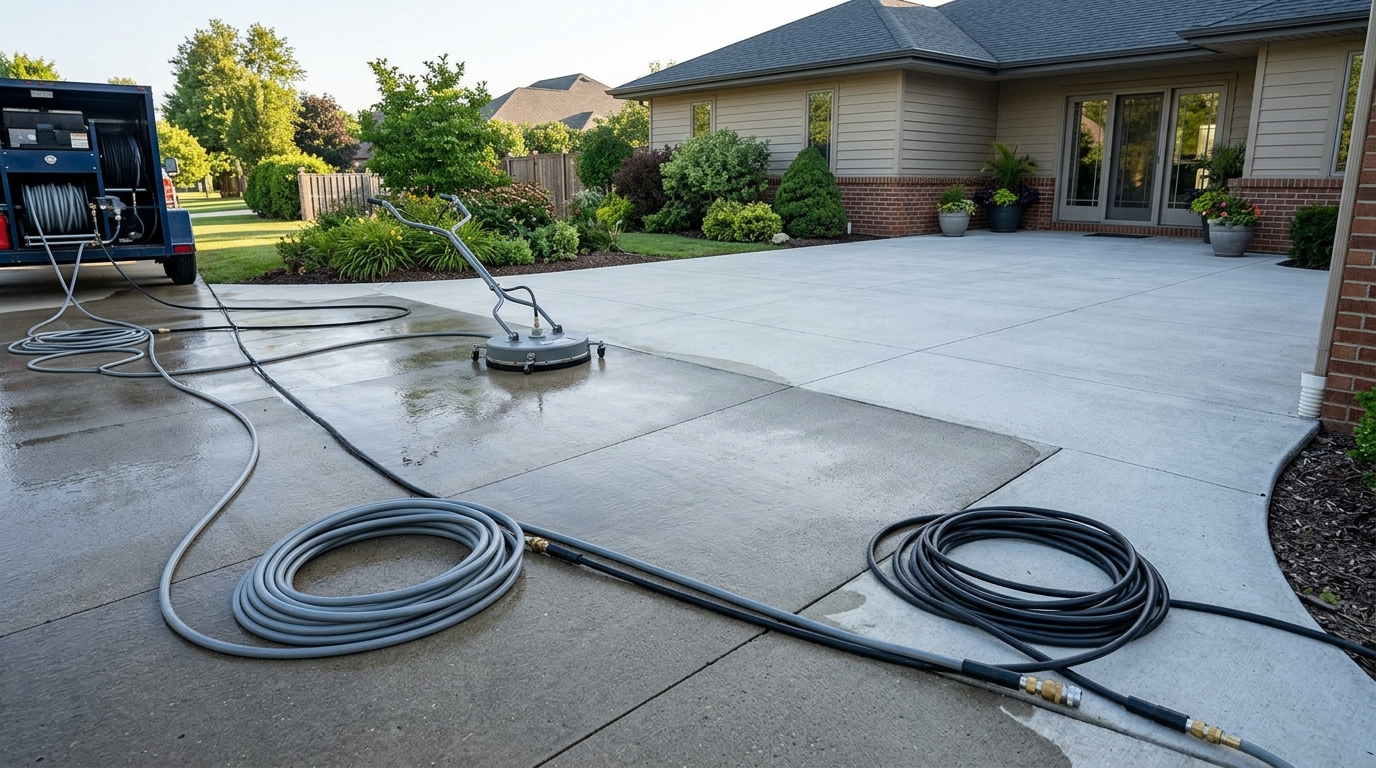
Picture sitting around the dinner table when someone asks: “Why does our neighbor’s driveway look like a zebra after they washed it?” It sounds like a funny puzzle, but it happens all the time. If you have ever seen concrete covered in light and dark bands after being cleaned, you are looking at what the cleaning industry calls 'wand marks' or 'tiger stripes.'
The short answer is simple: cleaning concrete with high pressure is just like drawing on a massive sheet of paper. If you use an ultra-thin marker and scribble back and forth as fast as you can, you leave behind obvious lines and uneven patches. Let's break down why those lines show up, why DIY cleaning often leads to them, and how trained techniques keep outdoor surfaces looking smooth and uniform.
Concrete looks tough and solid, but on a microscopic level, it behaves a lot like a hard sponge. Its surface has thousands of tiny pores where fine sand, pollen, road dust, and organic matter settle over time. When water blasts that buildup away, the contrast between the cleaned areas and the missed spots is stark.
The Three Culprits Behind Striped Concrete
When someone attaches a standard wand nozzle to a pressure washer and starts cleaning a flat driveway, several physical factors work against them:
- Inconsistent Wand Distance: When you sweep a spray wand by hand, your arm naturally moves in an arc. That means the nozzle is closer to the ground in the middle of your swing and higher off the ground at the edges. Where the nozzle is close, the water cleans deeply; where it lifts away, it barely touches the dirt. That height difference creates alternating clean and dirty bands.
- Irregular Walking Speed: Pausing for just half a second in one spot delivers significantly more cleaning action than moving smoothly across the slab. If the pace is uneven, the surface finish will be uneven too.
- Narrow Spray Angles: Pinpoint spray tips focus water into a tiny cone. While that creates high pressure, it only cleans a strip an inch or two wide. Trying to clean a two-car driveway two inches at a time almost always results in missed overlaps.
Is It Just Dirt, or Is the Concrete Damaged?
In many cases, stripes are simply dirty residue left behind where the spray path did not overlap properly. However, there is a second, more permanent reason stripes appear: surface etching.
Concrete has a smooth top layer called the 'cream layer.' If someone holds a high-pressure nozzle too close to the surface, the force of the water can actually carve away microscopic bits of this protective cement paste, exposing the sand and aggregate underneath. Once concrete is etched, those lines remain visible even after the surface dries completely because the texture of the material itself has been permanently altered.
How Professionals Prevent Lines and Surface Streaks
Avoiding stripes requires specialized equipment, consistent water flow, and methodical technique rather than brute force.
1. Rotary Surface Cleaners
Instead of relying on a handheld wand swung back and forth, professional technicians use a circular flat-surface cleaner. This tool houses a spinning spray bar with balanced nozzles enclosed under a protective deck. Because the nozzles stay at an exact, fixed distance from the concrete and rotate hundreds of times per minute, the water applies completely uniform pressure across every square inch.
2. Proper Overlapping Patterns
Even with advanced equipment, technique matters. Operators guide equipment in steady, overlapping rows—similar to mowing a lawn—ensuring that every pass slightly covers the edge of the previous one. This eliminates the thin margins where dirt usually hides.
3. Balanced Cleaning Solutions
Rather than relying purely on extreme water pressure to blast away stubborn grime, professional methods incorporate safe, targeted cleaning agents. These solutions break the bond between organic growth and the porous concrete before washing begins. By letting chemistry do the heavy lifting, the wash requires less abrasive pressure, protecting the slab from etching while achieving a deeper, longer-lasting clean.
Even, Restorative Care with Skinner Cleaning LLC
A clean driveway or walkway should enhance your home's curb appeal, not leave behind distracting patterns. Fixing existing striping or preventing it in the first place comes down to using the right tools at the right pressures.
At Skinner Cleaning LLC, trained surface-cleaning techniques bring even, streak-free results back to life on every outdoor surface. By combining regulated equipment, controlled rotary action, and surface-safe washing methods, Skinner Cleaning LLC lifts away deep-set grime without risking the texture and integrity of your concrete.